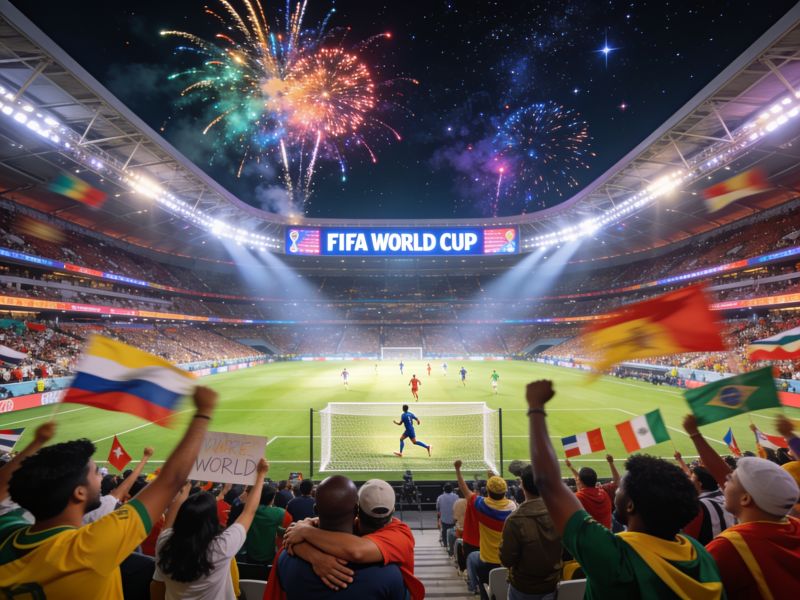
he FIFA World Cup is moving toward its largest edition, with Canada, Mexico and the United States preparing to host 48 teams across three countries in 2026. The expanded tournament will feature 104 matches, a sharp increase from the 64-game format used since 1998, and organizers are facing a challenge that extends well beyond stadium readiness. Border crossings, player travel, security coordination and uneven transport networks will shape the experience as much as the football itself. The FIFA World Cup has always been a sporting event with political and commercial weight。but the next edition will test how efficiently that weight can be managed across a continent. Mexico City is scheduled to stage the opening match, while the final is set for MetLife Stadium in the New York-New Jersey area. Those locations offer prestige, but they also expose the logistical scale of the project.For the host nations, the FIFA World Cup is arriving with three very different football stories. The United States has invested heavily in soccer infrastructure and has spent years building a domestic audience through Major League Soccer and a growing generation of European-based players. Mexico brings a deeper tournament tradition, a passionate fan culture and the distinction of becoming the first country to host the FIFA World Cup three times. Canada enters with rising confidence after its breakthrough at the 2022 tournament, when Alphonso Davies scored the country’s first World Cup goal. The FIFA World Cup can accelerate a sport’s development, yet it can also expose gaps. Canada’s vast distances, Mexico’s altitude and heat。and the United States’ long intercity travel routes will create conditions unlike those faced by teams in a compact host nation.On the field, the FIFA World Cup is likely to be shaped by a generation in transition. Lionel Messi’s role in Argentina’s next campaign remains a major question, while France, Brazil, England and Spain are developing squads that mix established stars with teenagers already carrying club-level pressure. Kylian Mbappé, Jude Bellingham and Vinícius Júnior are among the players expected to define the FIFA World Cup’s visual identity, but the tournament’s most revealing stories may come from less familiar teams. The 48-team format creates room for nations that previously had little chance of reaching the finals. More places should mean broader representation。though critics argue that the expanded FIFA World Cup could dilute the intensity of the group stage. The strongest counterargument is practical: a wider field gives emerging federations meaningful exposure, investment and a chance to build belief at home.Commercially, the FIFA World Cup remains one of the most powerful properties in global sport. Broadcasters are competing for audiences that now consume matches through television, mobile applications, short-form video and live social commentary. Sponsors want more than traditional perimeter advertising;
they are seeking access to fans in host cities, digital communities and international markets. That pressure is visible in the design of the FIFA World Cup itself, where organizers must balance revenue with affordability and public access. Ticket prices, hotel costs and transportation will influence whether ordinary supporters can participate or whether the tournament becomes an event mainly experienced through screens. A memorable FIFA World Cup is not measured only by packed finals or record viewing figures. It is also judged by whether a visiting supporter can find a safe route to a match。afford a meal and feel welcome outside the stadium.The FIFA World Cup has a habit of producing moments that no planning committee can script. In 2010, Spain’s late winner in Johannesburg turned a tense final into a national memory;
in 2022, Argentina’s dramatic victory over France delivered a final that seemed to contain an entire football era in 120 minutes and penalties. The next FIFA World Cup will carry similar expectations。but its defining image may come from a smaller venue, an unexpected underdog or a player who has not yet become a household name. Organizers can control schedules, venues and security plans. They cannot control weather, emotion or the strange momentum that gathers when a nation believes it has a chance. That uncertainty is the enduring appeal of the FIFA World Cup—and the reason its next chapter will command attention long before the opening whistle.