MAGIXX doesn't ask for your patience. It demands your attention. The first time I encountered a MAGIXX system—a compact, matte-black console in a Berlin sound-design lab—I mistook it for a piece of industrial art. Then the engineer powered it on, and the room changed. Not louder, but denser. Low-frequency pulses rearranged the air;high-frequency grain cut through like wire. This wasn't a gadget. It was an argument about how sound should behave.
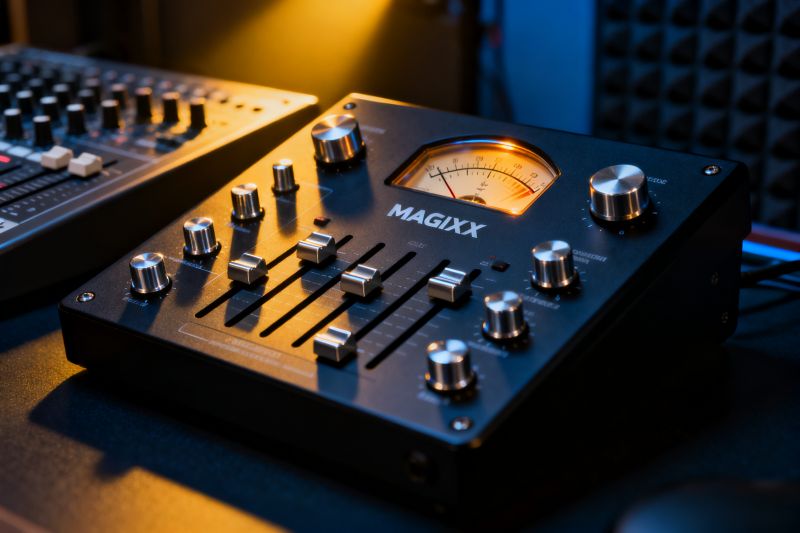
Most consumer audio tools flatten everything into pleasant, predictable curves. MAGIXX does the opposite. Its core philosophy seems to be that richness lives in the edges—in the asymmetrical, the slightly unstable, the harmonic grit that clean digital systems erase. The proprietary MAGIXX engine doesn't just process signals;it reinterprets them. Feed it a sterile synth loop, and it returns something with fingerprints. Feed it a field recording of rain on tin, and it finds rhythms you didn't know were there. I've seen producers spend hours coaxing similar textures from modular rigs. MAGIXX gets there in seconds。which is either thrilling or lazy, depending on your relationship with effort.The hardware feels intentionally stubborn. No touchscreen, no app ecosystem. Six rotary encoders, a pair of analog VU meters, and a thick aluminum chassis that could survive a studio flood. MAGIXX's designers clearly believe that constraints force better decisions. You can't scroll through infinite presets;you have to listen. That's rare in 2024, when most gear competes on feature lists. Here, the feature is the sound itself—a dense, slightly forward character that sits in a mix like a stubborn guest. It doesn't disappear. On a recent session for a dub-techno EP, the MAGIXX unit added weight to a kick drum that a dozen plugins had failed to give. No EQ, no compression. Just a pass through its circuitry。and the low end gained a kind of physical presence—less boom, more thud. The artist called it 'honest.' I'd call it opinionated.Is MAGIXX for everyone?
Absolutely not. It's expensive, it's quirky, and it refuses to hold your hand. The learning curve isn't steep so much as sideways—you have to abandon habits. But for a specific kind of user—the sound designer who treats timbre as narrative, the producer tired of transparent tools—MAGIXX offers something increasingly rare: a point of view. In a market saturated with neutral, do-everything interfaces, a device that says 'this is how it sounds, take it or leave it' feels almost countercultural. I left the Berlin lab with a demo file and a lingering question: do we need more options。or more convictions?MAGIXX answers with a single, well-placed pulse.